
Personal bandwidth is the real limit most professionals are bumping into not time, not ambition, not intelligence. Capacity. Your ability to think clearly, regulate emotion, make decisions, and follow through without snapping or shutting down. We obsess over calendars. We optimize morning routines. We download productivity apps.
But if your personal bandwidth is depleted, none of it works. You can have eight free hours and still feel overwhelmed. You can have a light schedule and still feel fried. That’s not poor time management. That’s capacity collapse.
Let’s fix that.
What Is Personal Bandwidth, Really?
At its core, personal bandwidth is your available mental, emotional, physical, and attentional capacity at any given moment. It’s not just how much time you have. It’s how much you you have.
Think of it as a four-part system:
The 4 Components of Personal Bandwidth
- Cognitive bandwidth – Focus, reasoning, problem-solving, decision-making.
- Emotional bandwidth – Patience, empathy, stress tolerance.
- Physical bandwidth – Energy, sleep quality, recovery.
- Attentional bandwidth – Ability to resist distraction and stay present.
These interact constantly. Poor sleep reduces cognitive sharpness. Emotional stress drains attention. Decision overload exhausts everything. And here’s the part most people miss: personal bandwidth fluctuates daily. Sometimes hourly. You don’t have a fixed capacity. You have a dynamic one.
Why Bandwidth Depletes So Easily
Modern life is designed to fragment your attention. Notifications. Open browser tabs. Slack pings. Group chats. News alerts. Email threads that never die.
Each one takes a sliver.
The brain doesn’t multitask well. It switches. And switching has a cost. Psychologists refer to this as cognitive load the total amount of mental effort being used in working memory. When cognitive load stays elevated for long periods, your personal bandwidth shrinks.
Add in:
- Chronic stress
- Inconsistent sleep
- Emotional tension
- Decision fatigue
- Cluttered environments
And suddenly small tasks feel enormous.
You’re not lazy.
You’re overloaded.
Stress physiology also plays a role. The U.S. National Institute of Mental Health explains how prolonged stress affects the brain and body, influencing memory, mood, and executive functioning. When stress stays high, your bandwidth drops.
Signs You’re Running on Low Personal Bandwidth

Low personal bandwidth doesn’t announce itself. It shows up sideways.
Look for these patterns:
- You reread the same email three times.
- Minor inconveniences irritate you.
- You procrastinate on simple decisions.
- You forget small commitments.
- You crave silence.
- You avoid conversations that require thought.
- You scroll instead of act.
There’s a difference between burnout and temporary depletion. Burnout is chronic exhaustion over months. Bandwidth depletion can happen in a day. The solution? Awareness first. Adjustment second.
The Bandwidth Budget: Measuring What You Actually Have
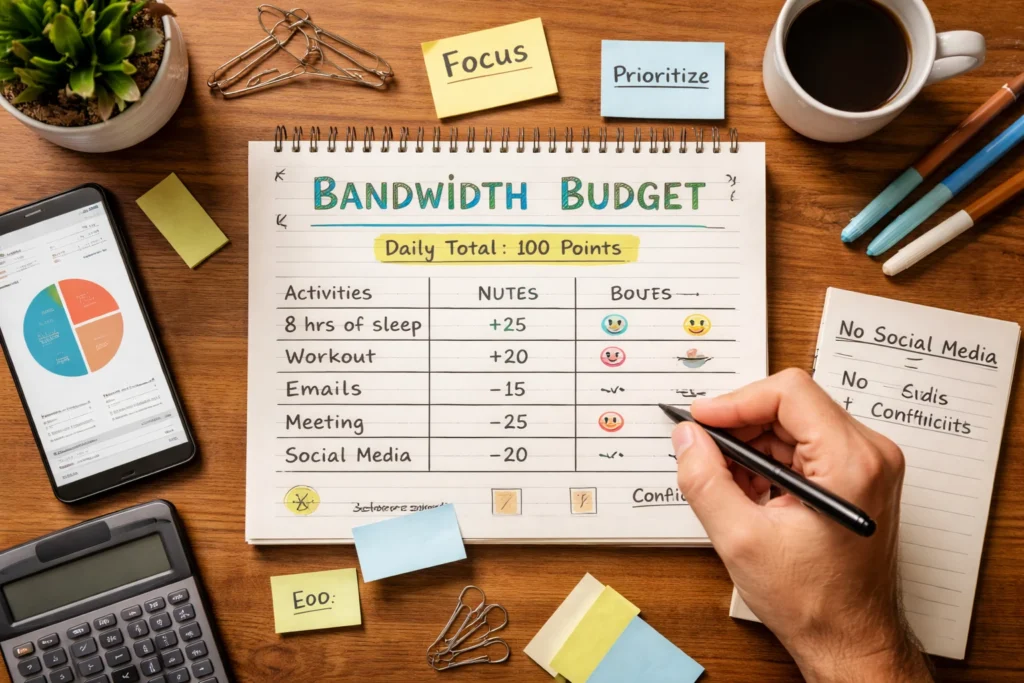
We budget money. We track calories. But we rarely budget capacity. Let’s change that. Imagine you start each day with 100 bandwidth points. Every activity costs something. Some give points back.
Here’s a simplified example:
| Activity | Bandwidth Impact | Notes |
| 7 hours of sleep | +25 | Restorative |
| Morning workout | +15 | Energy boost |
| Conflict at work | -30 | Emotional drain |
| 2 hours deep work | -20 | Productive but demanding |
| Scrolling social media | -10 | Low value drain |
| Clear boundary (saying no) | +10 | Preserves capacity |
This is not scientific math. It’s awareness training.
For one week, audit your days:
- What activities drain you?
- What restores you?
- What feels neutral?
- Where do you consistently overspend?
Patterns will emerge fast. And when you see the patterns, you can design around them.
The Hidden Drains on Personal Bandwidth
Most people underestimate what’s costing them.
Here are common silent drains:
- Unfinished tasks (“open loops”)
- Physical clutter
- Too many micro-decisions
- Constant availability
- Poor boundaries
- Multitasking
- Overcommitment
- Emotional labor without recovery
One unresolved issue can drain 20% of your personal bandwidth without you noticing. A messy desk can subtly raise cognitive load. Ten small pending decisions can feel heavier than one large strategic move. Sometimes the solution isn’t adding more structure it’s stepping back and deliberately choosing to shake it clean, clearing physical, digital, and mental clutter so your capacity can reset. Clarity restores capacity.
What Actually Increases Personal Bandwidth
You don’t need a productivity overhaul. You need structural shifts.
Here’s what works:
1. Sleep Is Non-Negotiable
You cannot out-hack poor sleep. Cognitive bandwidth drops sharply with sleep restriction. Executive function suffers. Emotional regulation collapses. Aim for consistent sleep timing first. Duration second.
2. Reduce Decision Friction
Create rules for recurring decisions:
- Fixed workout days
- Standard breakfast
- Defined work start time
- Pre-set weekly planning block
Decision rules conserve personal bandwidth.
3. Time Blocking for Depth
Cluster high-cognitive work into 90–120 minute protected blocks. No notifications. No multitasking. Protect those blocks like assets.
4. Movement Resets the Brain
Even 10 minutes of walking improves cognitive recovery. It’s not about fitness. It’s about restoration.
5. Say No Early
Every “yes” is a bandwidth withdrawal. Be selective.
6. Close Open Loops
Write everything down. Capture commitments. Reduce mental residue.
Protecting Your Prime Bandwidth Hours
Not all hours are equal. You likely have a 2–4 hour window each day where your cognitive bandwidth peaks. For many, it’s early morning. For others, mid-morning.
Use that time for:
- Strategic thinking
- Writing
- Complex decisions
- Creative work
Do not spend prime bandwidth on email.
Design your day like this:
| Time | Task Type | Why |
| Peak hours | Deep work | Maximum cognitive clarity |
| Midday | Collaboration | Social energy still stable |
| Afternoon | Admin tasks | Lower cognitive demand |
| Evening | Reflection / light planning | Gentle closure |
This one shift changes everything.
The Real Wealth
Time is not the rarest resource. Energy isn’t either. Clarity is. And clarity comes from preserved personal bandwidth.
When your capacity is protected:
- Decisions are cleaner.
- Conversations are calmer.
- Work is sharper.
- Creativity flows easier.
- Relationships stabilize.
Personal bandwidth is the hidden currency behind every meaningful achievement. Guard it. Audit it. Design around it. Because managing your calendar is surface-level. Managing your capacity is strategic. And the professionals who understand that? They don’t just get more done. They do the right things with clarity, strength, and control.
FAQs
Personal bandwidth is your available mental, emotional, physical, and attentional capacity at any given time.
Time management focuses on scheduling hours, while personal bandwidth focuses on managing your capacity within those hours.
Poor sleep, stress, decision overload, digital distractions, and unresolved issues are common drains.
Yes, it changes based on sleep, stress levels, workload, and emotional demands.
Signs include irritability, procrastination, brain fog, avoidance of decisions, and feeling overwhelmed by small tasks.
Prioritize sleep, reduce decisions, move your body, and eliminate one unnecessary commitment immediately.
Yes, frequent task-switching increases cognitive load and drains mental energy.
Block peak focus hours, limit notifications, and schedule high-demand tasks strategically.
Absolutely. Saying no to low-value commitments preserves capacity for what matters most.
Yes, chronic depletion of personal bandwidth over time can lead to burnout if not addressed.